Written by Scott Balson and published by Interactive
Presentations Pty Ltd in January 2004:

Back cover overview of "The Griquas of
South Africa and their Money "
"The Griquas of South
Africa and their Money" is an extraordinary book in many ways.
It begins by
giving an outline of the history of the "Bastard" people who were cast out of
the Cape in the 1700s. The history of the Griqua people, whose origins came from
the Hottentots, is woven into the fascinating history of their coinage. The book challenges many of the widely
accepted misconceptions and romantic notions about the actual use of
John Campbell's (1766-1840) "coins" allegedly issued in 1815.
It
is clear from this carefully researched book that the Griqua town token
coins were never used by the Griquas and were, therefore, not South
Africa's first currency.
Back cover of the book "The Griquas of
South Africa and their money" continues:
However, it is clear that the
Strachan and Co tokens, issued in the same year as the Burgerspond (1874), were
used by the Griquas in Nomansland (in a remote area on the eastern side of South
Africa)! Importantly the book provides many unique insights into the money
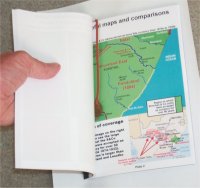
actually used and produced by the Griquas.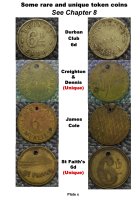
Images right and above:
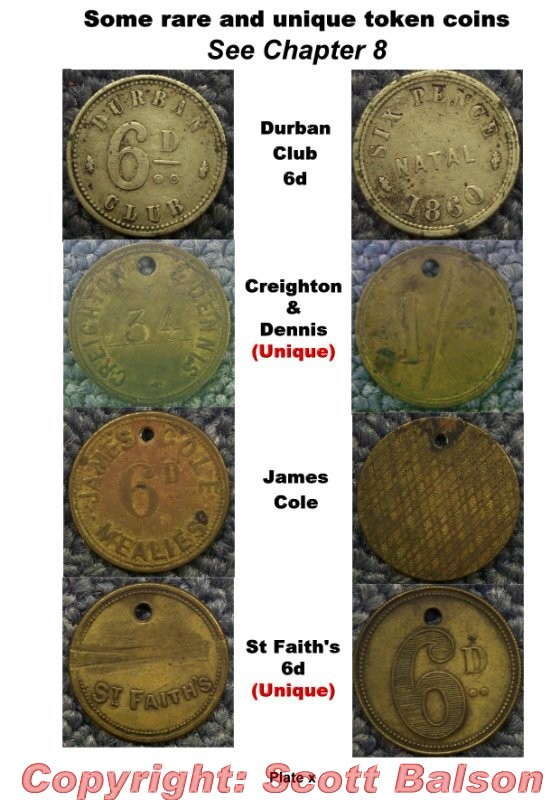
Two of many colour plates in the book - map and rare tokens from the East
Griqualand region
The printing and then destruction of the extremely
rare Griqua Pond note is covered in detail, with the book providing a
unique and fascinating insight into the workings of the Griqua Parliament that
ordered its production. The unissued note, dated 1868, was destroyed after one
of the major players in the book, Donald Strachan, personally intervened and
stopped its circulation.
The 1890 Proof Griqua Town Pennies are
discussed and various theories that have been canvassed by numismatists in the
past when trying to provide a background to their minting are either rejected or
validated using careful research. This fact alone makes this book an important
addition to anyone who has an interest in Griqua or South African coins.
Perhaps
the most important chapters in this book cover the acceptance of the Strachan and Co trade tokens as a
regional currency for over 50 years in Nomansland an area larger in size than
the independent South African states of Swaziland and Lesotho. The argument
supporting this claim cannot be disputed with references to Rev W Dower's book
"The early annals of Kokstad and East Griqualand" and the Standard bank
in Kokstad's fact sheet covering their 125 year history of doing business in
East Griqualand (see PDF linked to image below right).
Also included in this book is a detailed history of the F C Larkan token coins - the only South
African tokens issued by a woman. The histories of the Larkan tokens and those
of Strachan and Co are intertwined and reflect the importance of trade tokens to
the very existence of remote outposts like Nomansland in the 1800s. 
The book
also carries comprehensive statistical information on the four sets of Strachan and Co and the
various F C Larkan token varieties, their values (which are now set to rise
dramatically) and, uniquely for tokens, estimates on the tokens minted based on
coins counted by the author back in the 1970s.
This is a fascinating
work which will, without doubt, become the future reference book for
numismatists and coin dealers trading in the coins of the Griqua people.
The
author, Scott Balson, has a unique collection of Griqua coins and bank notes
collected over a period of 25 years. He has already written six books on various
subjects including the highly sought after work "Kence, the trade tokens of Strachan and Co" which was
published in 1978 and covers his research into the S&Co tokens at
that time. Finally the book has ten colour plates which give a glimpse into the
life and times of the Griqua people and includes a number of pages with the
Griqua coinage as well as rare and unique coinage from that region.
Return to top
Chapters in the book "The Griquas of
South Africa and their money":
- Introduction
- The Griqua town token coins of 1815 - 1816
- The Griquas on the move again
- The Griqua Pond Bank Note of 1868
- The trade tokens of Strachan & Co, South Africa's forgotten currency
- The 1890 Griqua Town "penny"
- The death of the Griqua nation
- The Strachan and Co "In Goods" sets
- The F C Larkan trade tokens
- Conclusion
- Strachan & Co Technical Information and Mintages
- Going Prices in US$ of Strachan & Co and F C Larkan token coins (as at
January 2004)
- Balson Holdings Family Trust Griqua Collection (as at January 2004) and
known Numismatists holding sets of S&Co
Colour plates:
- The Griqua town token coins
- Map showing the route taken by the Bastards/Griquas and the large area in
which Strachan & Co trade tokens were accepted as currency
- The unissued 1868 Griqua Note
- The four sets of Strachan & Co token coins
- Umzimkulu in 1883
- Donald Strachan and his five sons
- The Griquas final stand under Le Fleur - 1898
- The differences between the two sets of Strachan & Co "In Goods" trade
token coins
- The F C Larkan tokens and their varieties
- Some rare and unique tokens from Nomansland
Return to top
PLEASE NOTE THE BOOK IS NOW
SOLD OUT Order the book by mail in Australian dollars
from this link. The paperback book, has 44
pages and a further 10 pages of colour plates with historical photos, maps and
high quality coin images. The book sells for US$20. Postage US$5 per
order. (Note the first 20 copies of the book numbered and signed by
Scott Balson and carrying a Strachan and Co 3d "In Goods" attached to the
end of a thin leather bookmark and bound into the book have now been sold. The coins in these first 20
books were included to commemorate the Griqua Pond bank note carried in Dower's
book "The Early annals of Kokstad
and East Griqualand").
Return to top
|
Hi Scott,
Received your new token book and eagerly devoured it! Well done! Lots of
new info that answers many key questions about the Griqua and leads one to
search for more. Keep in touch, Rege Podraza, USA
(Rege Podraza is a
major collector of Griqua
coins)
Rege's web site
Dear Scott The book will be a joy and a jealously guarded addition to my
library. This boasts several thousand books and reference works, mostly on
British coins - some going back to Cromwellian times - but, more
importantly now, a belatedly burgeoning collection of reference works on
our own series. The illustrations are great. They add that little extra
touch of class. It's AWSOME, and thanks again. Allyn Jacobs (S Africa)
(Allyn Jacobs is a major collector of Griqua coins and played a major
research role in the publication of Hern's
book on S African tokens)
Dear Scott I finished reading your book last night. I enjoyed it and it is
always nice to come across new information about the company. I always
thought that the minting of the tokens was a shrewd business move but I
never realised that they were so widely used in the Transkei. I wish I had
read your book before printing mine as I would have made more of a fuss of
the tokens. Thank you for the complimentary review of my book on your
website. I enjoyed the homework pun! Your website makes the company live
beyond 1984. It would be sad if all that history was forgotten. Regards
Milner Snell
Trustee, Kokstad Museum
Hi Scott
Have been trying to find any
evidence that the Griqua town token coins been used in and around Griqua
Town for more than a year now and could not find any.
Looks like old Campbell was just a dreamer.
Keep up the good work Scott and stay in touch.
Regards
Daniel
About South Africa
|
Return to top
Bullet Point Summary of over 50 Key
Points exposing the Griqua town token coin fallacy
In response to Pierre Henri Nortje
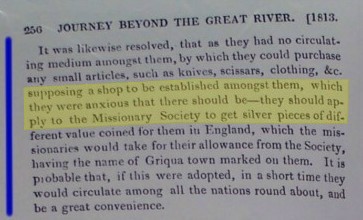
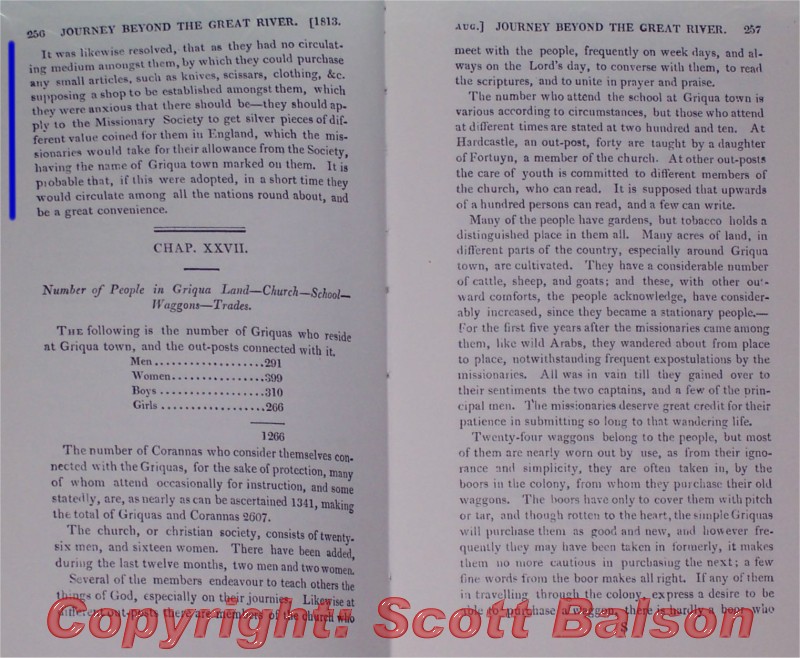
Scan of the comment by Rev John Campbell published
in his 1815 book covering his first trip to South Africa. |
Scan of the misleading extract out of the book
recording Rev John
Campbell's first visit to South Africa (1813) that is
constantly referred to by numismatists. This fantasy is predicated on
this statement "supposing a
shop (first) to be established amongst them,
which they were anxious that there should be -
(then) they should apply to the Missionary
Society" (ie used on the same basis of the success
of the Strachan & Co currency tokens).
My additions clarifying basis shown in brackets
and in red. Without a shop how would they have traded
the coins? There was no shop at Griquatown until decades later! The Griquatown "coins" were never anything more than novelty pieces and were NEVER used as coinage by the
Griqua. Read below to
see that any claim they were currency is
ridiculous.
Disrgarding the many facts detailed with links below one has to look no further than the experience of the owners of the Strachan stores in East Griqualand fifty years later. They also initially issued tokens in 1870 with no holes in them.
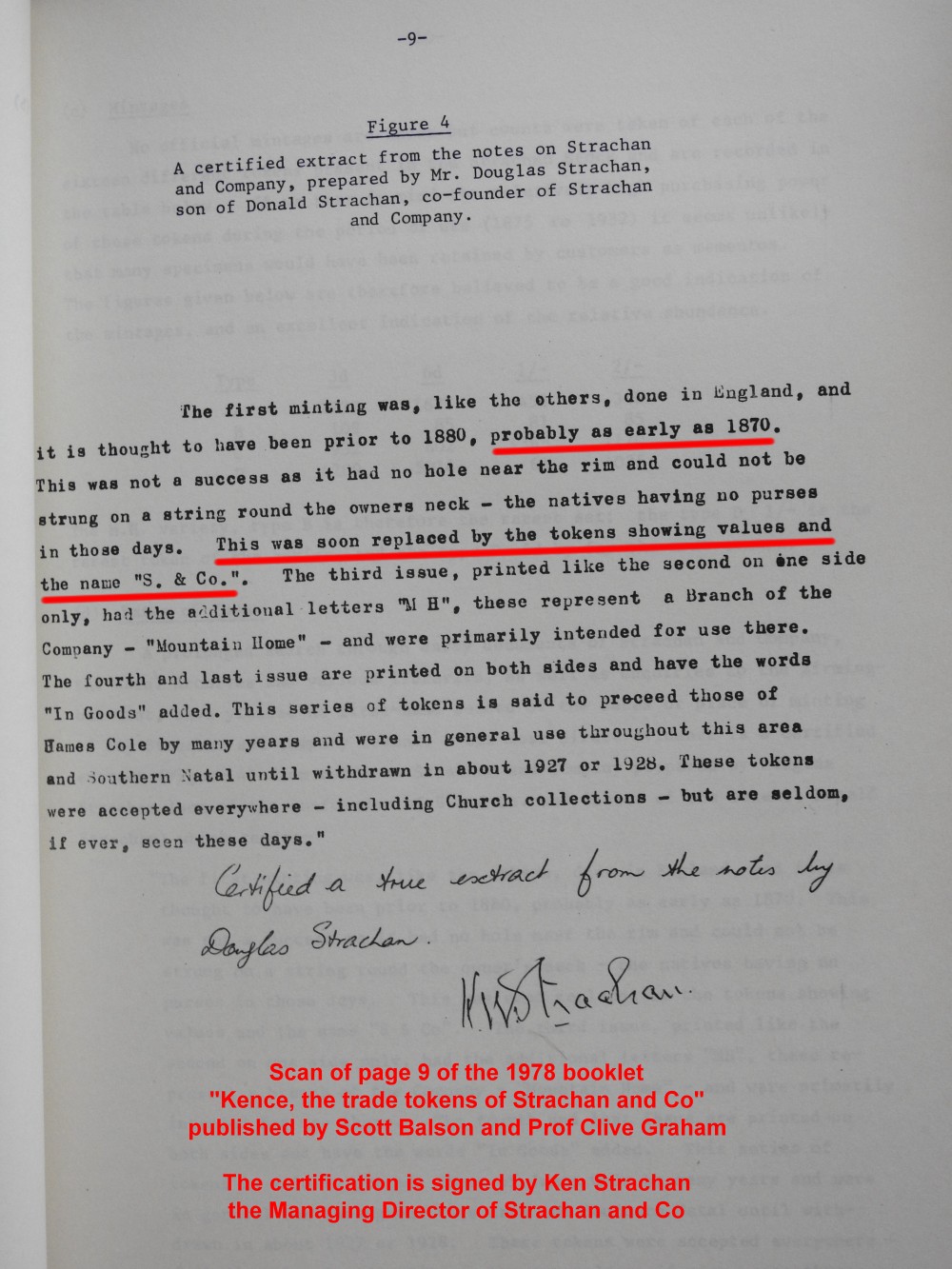
Despite the fact the stores offered a place to trade the coins (something that did not exist in Griquatown in the 1820s) the son of the founder of Strachan and Co wrote in his diary notes certified as accurate by the last Managing Director of the company, Ken Strachan:
The first minting was, like the others, done in England, and it is thought to be prior to 1880, probably as early as 1870. This was not a success as it had no hole near the rim and could not be strung on a string around the owners neck - the natives having no purses in those days.
Its logical that the Griquatown tokens fifty years earlier would have faced exactly the same hurdle as they had no hole and this would have been exacerbated by the fact that there was no trading store to use them.
Source: Complete diary note scanned from page 9 of the book "Kence the trade tokens of Strachan and Co" published in 1978 by Scott Balson and Prof Clive Graham
In March 2017, Morgan Carroll's contracted independent research on the subject of the Griquatown tokens through a highly qualified researcher, Ann Stuart.
Click on the large text below in the red box to see the highly detailed 12 page research supporting and endorsing Balson's prior research carried below that, regardless of intent, the Griquatown tokens were a complete failure and never circulated.

|
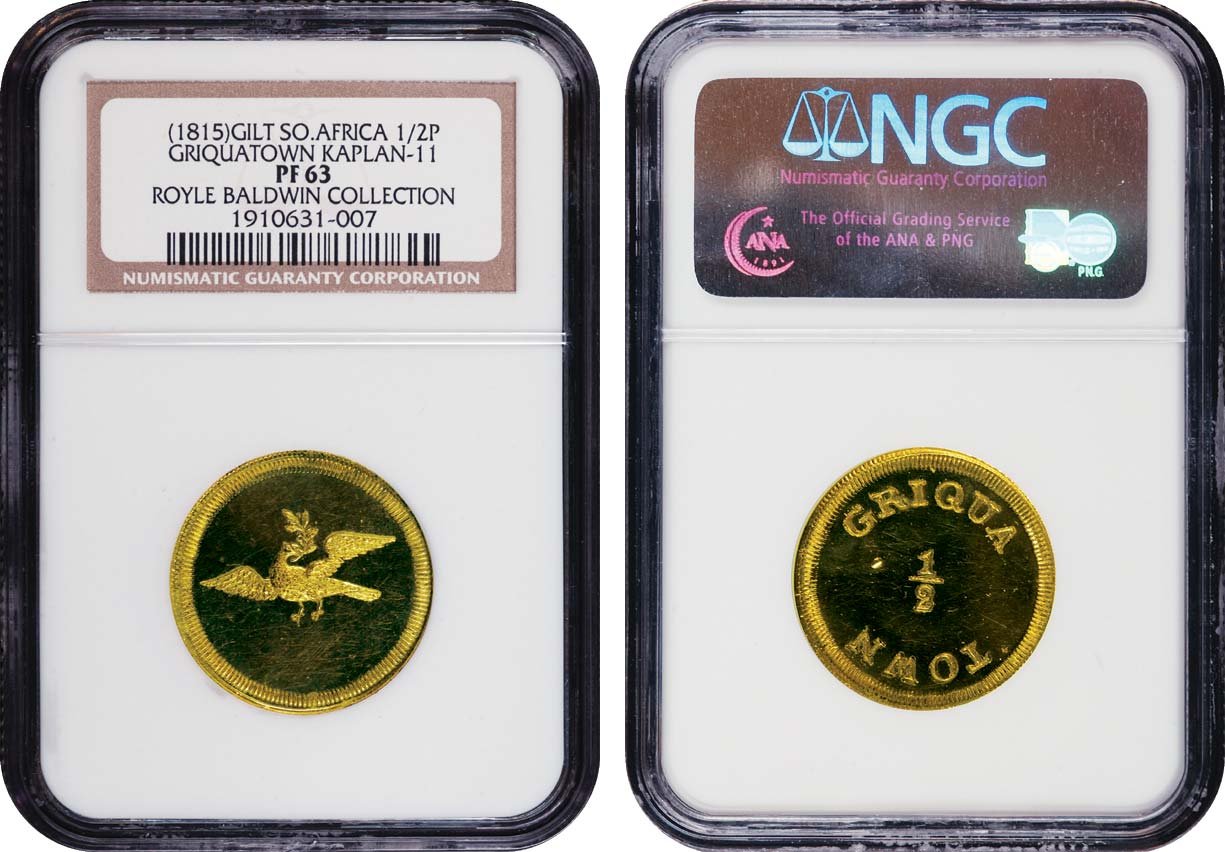
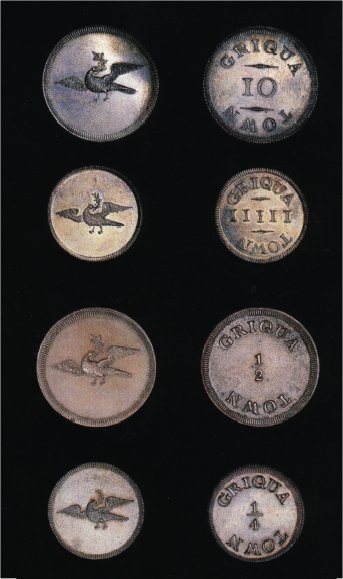
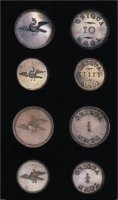 (to see the controversial "Griqua town token coins"
click on image right)
(to see the controversial "Griqua town token coins"
click on image right)
| The Cape Coloured People
1652-1932 by J S Marais, is a lengthy and well researched work
(over 60 books referenced). The book includes a detailed report on the
Griquas at Griqua Town (Chapter II pgs 32-73) but makes no
reference to any coinage being used there. Marais, the Professor
of History at the University of the Witwatersrand, refers at length to
Campbell's book and the meeting where the Bastards adopted the name
"Griqua", incorporated new laws and in which Campbell mentions the idea of
coins. It is clear that Marais had, by his omission, completely discounted
the theory that Griqua town token coins had ever circulated at Griquatown.
This observation is supported by Marais' own commentary in the book that
between 1814 and 1820 Griqua Town was a "ghost
town". His views,as will be seen in the points below are supported by the research of Prof Arndt (University of Pretoria) and South African researcher and historian Karel Schoeman.
|
FACT: The
"1815/16" (should be 1820) Griqua town token coins have no demonstrable
relevance to South African numismatics at all (apart from being a failed experiment).
Facts confirming that they were nothing more than token coins
- There is no date on these coins, this is common to patterns and
token coins - no one is sure when they were minted.
- The London Missionary Society's (LMS) report 1815-16 states that there was
"no money in Griquatown" - (Karel Schoeman) source here.
- In 1816 the LMS report on the Griquatown Mission refers to the Directors procuring for the Griqua a coinage of
silver tokens (source
here).
- There is no identifiable denomination on the coins (like other
South African tokens)
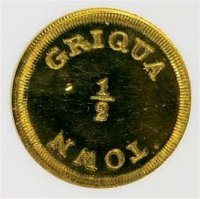
- There are several records of the Griqua town token coins being struck
in other metals like gold and even others with a value of "100" - common
to patterns - see images right and below.
- Trade token coins issued in South Africa from 1860 (such as Durban Club; Strachan and Co) to 1932 all carried values based
on British currency - such as 3d, 6d, 1/- and 2/-.
Practical reasons why Griqua town token coins never circulated and did not exist in 1815/16
- The bronze pieces are as rare or rarer than the silver pieces -
common to pattern issues and making the concept of giving change a
nonsense
- The gap between the "IIIII" in silver and the 1/2 in bronze requires
ten coins to change just one silver - a nonsense, no currency has a gap this
big and as the bronze are so rare how could giving change work? Read Scott's view on the values here.
- Campbell's own letters in 1820 (see Schoeman reference in links above) confirm that their acceptance by the Griqua depended upon the Dutch trading stores south of the Orange River accepting them. They never did, nobody did.
- The reason trading stores refused to accept them is quite simple. The coins had no parity with British coins or the Rijksdaalder making them
useless and no "value" was ever agreed upon for the silver pieces. The reason Helm never circulated them and the reason the Griqua refused to accept them.
- There is strong evidence that Rev Campbell brought these token coins to South Africa in 1820 on
his second trip long after they were supposed to have circulated and been withdrawn.
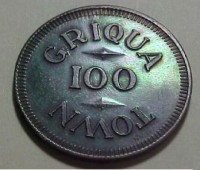
Image right: The Griqua 100 Pattern in bronze passed in on eBay in 2008 with a reserve of "just" US$3,000
- There was no store at Griquatown in 1815/16 or even in the 1820s
- There was no bank at Griquatown in 1815/16 - the first bank appeared there 100 years later in the 1900s.
- There was nothing on which to base their introduction into the
community at Griquatown
- Helm
complained in writing in 1821 that the Griquas refused to accept the token coins - source here.
- Traders south of the Orange River refused to accept the coins making them
worthless - source here.
- The entire "trade" of the Griquas (spread
throughout the region) in 1815 was only worth
ZAR100 per annum - even this figure (by
Campbell's own admission is exaggerated).
Reference to trade claim "From Barter to
Barclays" by Eric Rosenthal.
- Even Campbell noted in his second trip in 1820 that regular trades did
not exist in Griquatown
- All trade in Griquatown at and after this time was by barter - as
described in various reports by Missionaries and hunters.
- Griqua Town was a "ghost town" in 1815/16 (the time it is alleged
they "circulated as currency" - the population scattered in
1814. Campbell confirms just under Griqua
700 adults spread across the entire region in 1813 BEFORE they
scattered.
- The resident population of Griquatown scattered in 1814 returning to their nomadic lifestyle
after a major fall out with the missionary, Anderson. Less than 100
men, women and children remained.
- The Griqua population lost faith in Anderson in 1814 so why would the few that remained in Griquatown
have any faith in Anderson's token coins? See Rev
Philips comments on this here.. note no mention is made by him of any Griquatown coins.
- The coins were not holed so could not be carried with their beads
around their necks - they would have been lost. Examples of holed copies found
today are those used as jewellery - but never circulated.
Lack
of mention in contemporary records
- There is no contemporary written record of the coins ever
circulating at Griquatown (not even by the Missionaries Moffat, Philip,
the resident missionary Anderson, Livingstone or Campbell or in the LMS
Reports). For example, in Robert Moffat's book "Labors and Scenes in
Southern Africa" the missionary covers Griqua life at Griquatown at this
time in details - including the dramatic fallout with Anderson. Not one
mention is made at any time in this book of "Griquatown coins". (See pages
100-150). More on the book at
this link.
- While there is mention of silver Griquatown tokens by Helm, Campbell and others in 1820 NOT ONE MENTION
is made of the bronze 1/4 or 1/2 pieces. There is no contemporary evidence that they were actually minted for use at or arrived at Griquatown. Could this explain while they are as rare as the silver pieces. ie only a few were minted at a later date and these bronze pieces are totally irrelevant to South African numismatics.
- The coins were only issued after 1816 - as in the LMS report (1815-16)
they talk about issuing silver token coins as
there was no money in the region. (Source Karel Schoeman, "The Mission at
Griquatown 1801 - 1821".)
- Both Moffat and Campbell refer to Rix Dollars being occasionally
accepted by Griquas when trading in the Cape before and after 1815/16
- In Campbell's 1834 personally edited journal of his first trip
he omits any reference to the Griquatown token coins (the 1815
book on Campbell's travels to South Africa is a transcript of his diary
compiled on this same trip). His omission confirms the fantasy - details and scans at this
link
- Not one Griqua met by Balson know anything about these
coins. (Balson has met with the leadership of all the main Griqua
communities around S Africa in 2006 and 2007). The only leader to have heard about them
was Waterboer at Griquatown and that is because of coin collectors approaching
him in the past. (Griqua history is verbalised and past events are recorded in
stories and fables passed down from father to son - none mention the
Griquatown token coins).
- The Rev John Philip accompanied Rev John Campbell on his second trip to
South Africa - having been in the country from the early 1810s. In Volume Two
of his 1828 book "Researches in South
Africa" he quotes the London Missionary Society's William Anderson
verbatim at length. Anderson while describing life at Griquatown makes NO
REFERENCE AT ANY TIME to the "Griquatown token coins" (pg 57-62) during
any period. A scan of this evidence can be seen by going to Google
Books at this link, searching on "Anderson" or the
relevant extract copied to this website at this
link.
- There is not one mention of the tokens as assets in the detailed records of the assets of the London Missionary Society in Griquatown at this time. See the detailed report here.
- In the 1995 book Weapons of Peace by Peter S Anderson the author, a descendant of William and Johanna Anderson,
makes no mention of the Griquatown token coins while relating their lives in Griquatown. In this 200 page softcover book Peter had access to original letters written by Anderson and talks at length about the fall out Anderson had with the missionary in 1814 resulting in Griquatown becoming a ghost town. In fact the author states it is extremely unlikely in this 2016 email to Balson that the tokens circulated and found no mention in William Anderson's letters or journals of that time. Source.
- Karel Schoeman's book on "The mission at Griquatown
1800-1821 based on extensive research into the London Missionary
Society and Cape Archives reflects the fact that the coins were a
dismal failure and never circulated.
- Prof Arndt's 1928 book... The coins were of
four denominations, viz: ¼ and ½ in copper and IIIII and 10 in silver. These
were sent at a time whn these coloured people had not the slightest notion of
the advantages of a metallic currency. Moreover their entire trade at the time
did not even amount to fifty pounds per annum. Accordingly it is not surprising
that “the dove of peace soon flew away and the money of which never a
single farthing was in circulation accompanied it”. The only permanent
memorials of Campbell’s visit turned out to be the names “Griqua” and
“Griquatown”. (Source: Prof Arndt (p 127) "Banking and Currency Development in
South Africa 1652-1927"). The relevant footnote states:
Hofstede, p 89; Gunning p 172. No information is available as to the
amount that was issued. Campbell, strange to say, has nothing to say on his
currency and his codes of law in his book on his second visit to South frica
in 1819.
Campbell, the weak man, prone to drinking and
fantasizing
- Moffat clearly slates Campbell as being a liar and "building castles in
the air" and
- states that Campbell was a drunk who, in this state, would
fantasize, eg the diary note about introducing coins transcribed in the book on his first trip to South Africa (1815) - and scanned above.
- Campbell admits in his own writings he was prone to writing
fantasy Source his book: Walks of Usefulness
- The Quarterly Review (1815) slammed Campbell's book as
nothing more than a largely inaccurate record of his trip. The 22 page review
provides documentary evidence of lies and distortions in the work in which
Campbell flags the idea of having coins made for the Griqua.
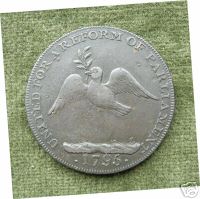
Interestingly, the use of the dove and
olive branch image, the emblem of the London Missionary Society, was
first used in the 1790s on token pieces issued for the London Corresponding
Society (LCS) run by a group of individuals wanting to reform the British
Parliament - more on LCS at Wikipedia. The two groups were
closely aligned. These earlier tokens sell today for just a few dollars
(see image right).
The practical reasons the Griquatown token coins failed
- Without a store how and where would they have traded them?
- The only place they could be traded was south of the Orange River and
trading stores DID NOT recognise them - source
here.
- The Griquas were illiterate - could not read nor write - there was
no school north of the Orange river
- The Griquas could not count - they would not have known what to do
with the coins or how to use them. (Let's get real. How could a Griqua
understand fractions? A large percentage of today's "educated" adult
population doesn't!)
- The Griquas were inherently "lazy" and not industrious - their only traditional
activities were shepherding their livestock, hunting and barter.
- The entire male population in the region around Griquatown was just 291
in 1815, see points below, and this number fluctuated greatly as it was a
transient population - many living off plunder and the chase.
- The Griqua leader Waterboer refused to accept the Griquatown token coins
and was paid for his services in Rijksdaalder - source here.
- The Griquas would leave Griquatown and travel inland to other
settlements for months at a time hunting and horse riding
- Between 1814-20, the very time the coins were supposed to be circulated
in Griquatown, the settlement became a "ghost town" with just a few few
nomadic Griquas using the station as a temporary camp before moving on.
- The only permanent resident at Griquatown in 1815/16 was the Missionary
William Anderson, the only gardens those of the Missionary.
- As recorded by Rev Philip the
Griqua lost trust in the London Missionary Society's resident missionary
Anderson over the Cape Regiment fiasco in 1814.
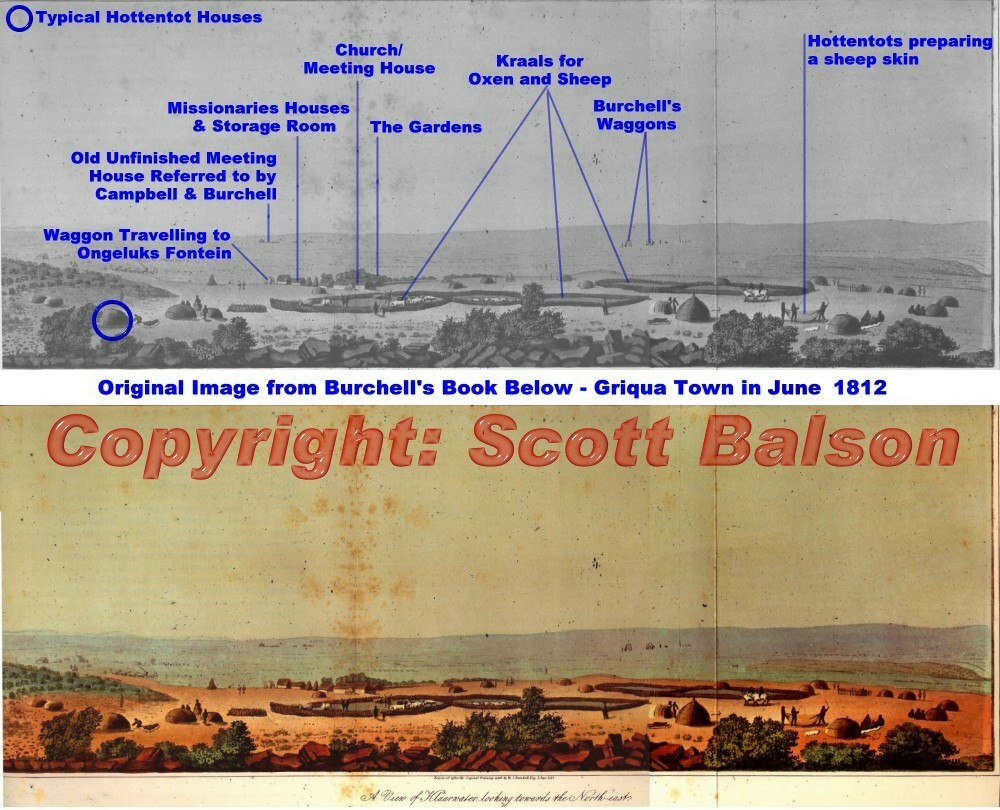
- In 1812 BEFORE Griquatown became a ghost town it boasted just 25
traditional Griqua huts (made of branches and mud), three kraals for
livestock, a Church, a Missionary store room (for produce harvested from the
Missionary's garden) and the Missionary's mud house (see image below).
- In 1821 Rev Helm refers to having a bag of
Griquatown token coins that were never used and asks the Society what
they wanted to do with them. (Source Karel Schoeman, "The Mission at
Griquatown 1801 - 1821".)
How did fantasy become
"fact"?
- All subsequent references to the Griquatown
token coins being "accepted as currency in Griqua Town in 1815/16" can be
tracked back to just one article - by H A
Parsons - republished from an earlier Spinks catalogue in 1927
- Many of Parson's assumptions made in this article have been shown on
this page to be flawed and not based on fact (for example his fabricated
claim that they circulated from 1815-16)
- Parson's research is extraordinarily poorly researched. He
documents the limited (three) sources behind his work - naming only Moffat,
Livingstone and Campbell (not his later work where he omits any reference to
the coins). The all-telling drawing by Burchell, below, and Philip's
telling observations were somehow overlooked.
- As recently as 2008 Brian Hern in his catalogue on South African coins
continued to push the lie that the Griqua town token coins circulated in
1815/16. Hern is aware of this website and has never replied to the facts
presented above. You can see Balson's responses
to Hern's most recent claims at this link.
- The reason the points above are ignored by Messrs Hern etc.. are
financial. If they were bona-fide numismatists they would either enter
into a debate on this issue, do their own research in what has been raised
here and rebut the evidence or accept that the whole thing is a hoax.
Spink have already accepted that Parsons was
wrong.
If you are still not convinced then look at the
drawing below of Griquatown as at June 1812 - a picture tells a thousand words.
The drawing was undertaken by William Burchell on behalf on the Missionaries at
Griquatown and is bound into his book "Travels into the Interior of
South Africa" (See Volume One page 282)... click the thumbnail
image below to see details... Moffat reports Griquatown as appearing the
same ten years later - long after the Griqua town token coins were supposed to
have circulated there "as currency".
| Travels in the interior of South
Africa - William Burchell Extract pg 350-52 (volume one) But
the first glance now convinced me how false may oftentimes be the notions
which men form of what they have not seen. The
trees of my imagination vanished, leaving nothing in reality but a few
which the missionaries themselves had planted; the church sunk
to a barn-like building of reeds and mud; the
village was merely a row of half a dozen reed cottages; the
river was but a rill; and the situation an open, bare, and exposed place,
without any appearance of a garden, excepting that of the
missionaries. |
Scott Balson's visits to
Griquatown:
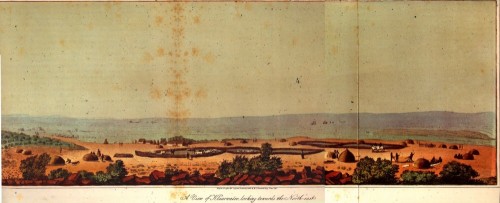
Burchell's 1812 drawing of Griquatown from his book
See
Scott Balson's visit to Griquatown in 2006 where he photographs the small
settlement today from half way up the watertank above the spot where Burchell
drew this image.
See Scott Balson's visit to Griquatown in 2007 where, during
his book launch of "Children of
the Mist", he photographs the small settlement today from the top of the
watertank above the spot this image by Burchell was drawn.
Return to top
'n Griekwa "Ietsigeit" - rare
book by D H Van Zyl claims coins minted in 1874
The foreword of this book by E G Jansen tells us that van Zyl
studied the Griqua and the Bushmen in the first half of the 1900s. The Internet
and the foreword tells us that van Zyl was a Senator who accompanied an expedition in 1950 to
"study and document how the bushmen lived".
What is know is that Senator van Zyl had a special interest in the
Griqua - as reflected by the photos he took in Griquatown of the Waterboer
family and other Griqua communities in the region. In his book he looked at
their language, their humour, their lives and, interestingly, the "Griquatown
token coins".
On page 18 of his book van Zyl discusses the Griquatown token coin
controversy after speaking to the Griquas of Griquatown in the early 1900s -
none knew of the Griquatown token coins. van Zyl says: "Byna gelyktydig met die
verskyning van die Griekwa-mutstukke (1874) het ook die eerste Transvaal geld op
die toneel verskyn, nl. die bekende Burgersponde." (translation: At
about this time the Griqua coins (1874) and the first Transvaal coin appeared -
the famous Burgerspond") - scan of extract below. The comment is accompanied
by a photo of the Griquatown half piece.
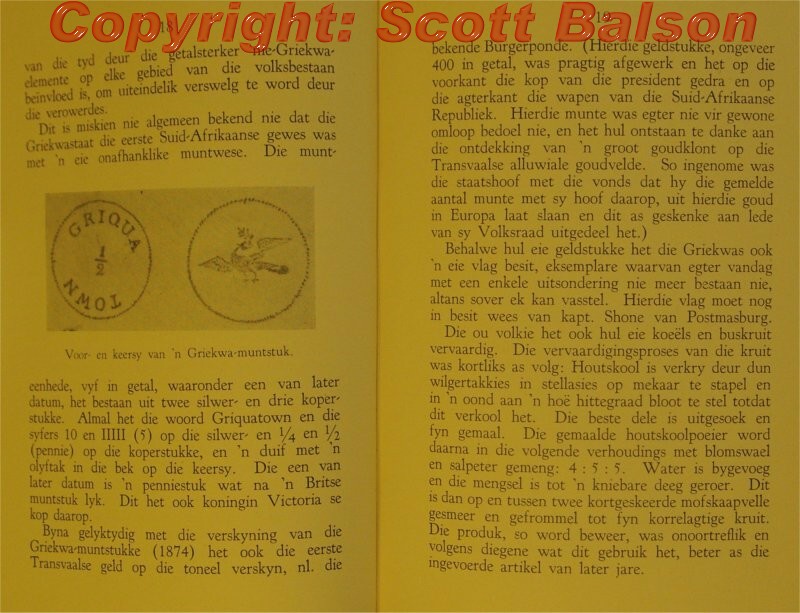
More on this book at this
link
In the extract above van Zyl gives another incorrect theory about the Griquatown token coins.
They did arrive at Griquatown in about 1820 (not 1874) but not one of these token coin ever circulated; as proven on this page.
Return to top
The argument by those who hang on to the
belief the Griquatown token coins circulated The argument
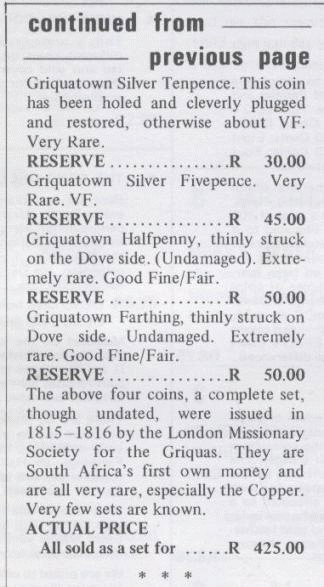
often given that the Griqua town token coins is their apparent "circulated"
status as can be seen in this 1969 Bickels Coins
and News extract. In response to this furphy we would note the
following:
- These token coins are over 100 years old - if they were not
maintained properly they would wear. The clearly pattern 1890
Griquatown pieces are often found in worn
condition. Yet condition is often presented as "proof" that the
Griquatown pieces circulated. Tragic!
- The type of wear that I have seen on Griquatown token coins (severe) does
not reflect a coin in circulation over a short two year period, (but hardly
used according to those who say it circulated). They are simply simply
coins badly stored. Even the proponents of the fable that they circulated
admit that it would have only been for two years - the severe wear on some of
these coins would not come from circulation over such a short period. Furthermore several Griquatown tokens are very worn on one side and nearly Uncirculated on the other. How can that be anything BUT bad storage over a long period of time?
- No argument to the 50 points raised above has ever
been presented - they are simply ignored.
- Of course those that stick with the fantasy that the Griqua town token
coins circulated are not interested in doing the hard yards and researching
this subject themselves. Often they own a Griquatown piece/s and their head in
the sand response to common sense reasoning (above) simply reflects their fear
of the loss of value in their "investment" in the piece they claim to be S
Africa's first circulating indigenous coin.
- Hern in his latest catalogue on South African coins continues to suggest that the Griquatown token coins
were South Africa's first indigenous coins despite being aware of the
evidence displayed here.
- Helm's comment that the tokens were "disposed of a too cheap a rate" is suggested by those who claim the tokens circulated is the reason they failed - erroneously suggesting their value as money in Griquaotwn had become unclear. You will see hear the context of that term back in the 1800s - ie the value is not unclear BUT the fact that something has been given or sold too cheaply is.
Return to top
Over 20 Key Points why the Trade Tokens
of Strachan and Co were South Africa's
first widely circulating indigenous
currency....
Full
background supporting points below at this link
What
about the Griqua Town and Burgerspond?
- The story that the Griqua town token coins circulated in 1815/16
is a complete fabrication (see above)
- There were very few gold Burgerspond pieces struck in 1874 and few
circulated - being kept as keep-sakes
Practical Evidence
Supporting the fact that the Stracahan and Co currency tokens were South Africa's first widely circulating indigenous currency:
- There was a dire shortage of change in Nomansland/East Griqualand up to the late 1800s and regular trades DID exist
- In the diary note by Douglas Strachan son of Donald Strachan (the company's founder) he states "These tokens were accepted everywhere - including Church collections...." Source - see last line
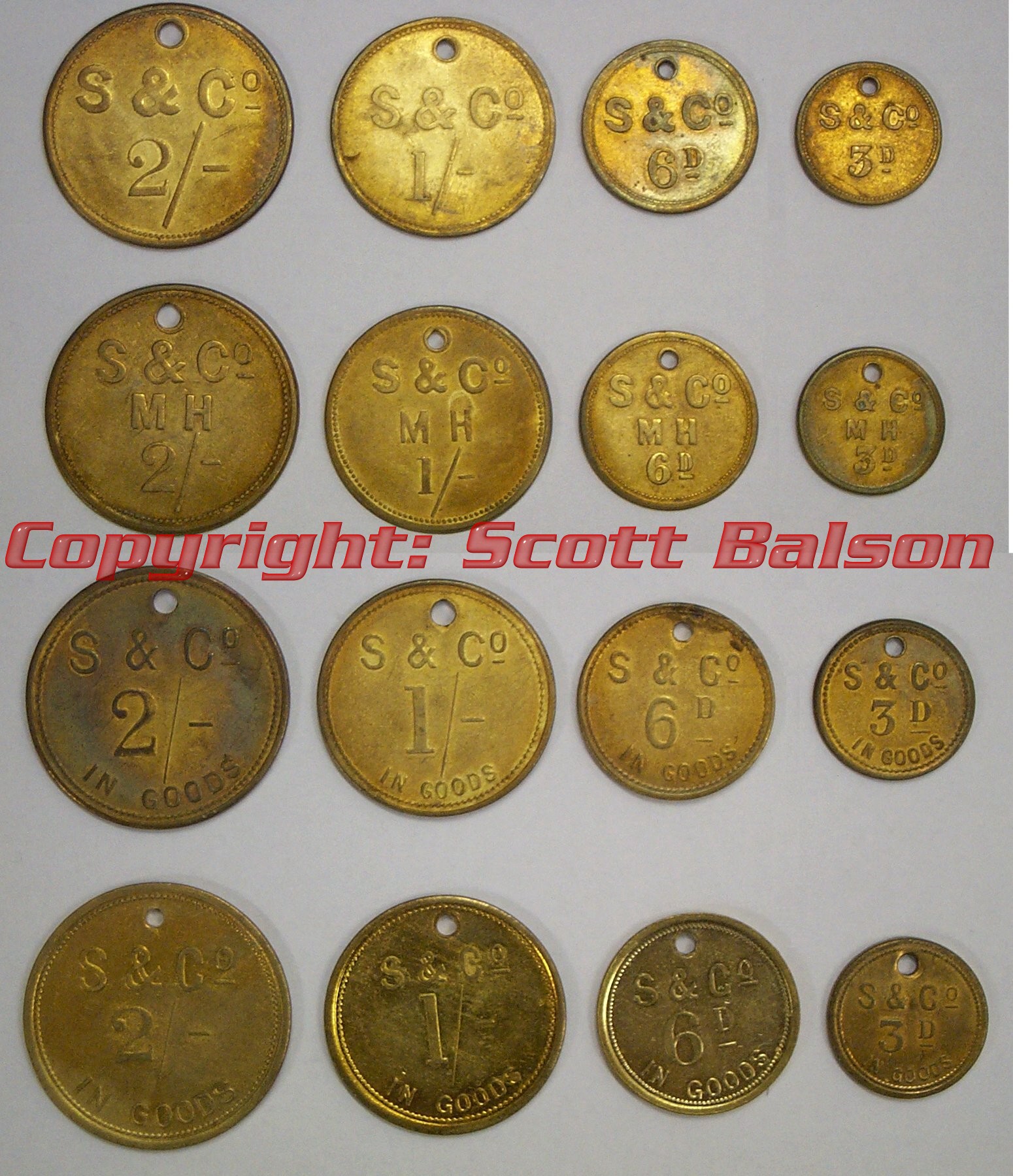
- There were up to 100,000 S&Co pieces struck in four identifiable
sets over a period of 50 years to cater for demand (most of these tokens
have since been destroyed) - See the coins at
this link.
- The first set (S&Co) circulated for nearly 60 years between 1874 and
1932, the Mountain Home (MH) from 1904, with the later "In Goods" sets circulating for about 20 years
- Most S&Co trade tokens are well worn - reflecting their use
over many years
- S&Co had trading stores spread across East Griqualand from the early 1900s - these
acted like "banks"
- The Standard Bank in Kokstad accepted and handed out the S&Co
coins from its opening in 1878 - this is documented.
- In a similar manner the trade tokens of James
Cole were later accepted as currency across East Griqualand from the late 1800s.
- Many other trading stores in this remote region tried to emulate the
success of S&Co by introducing their own coinage - but few succeeded
as the Africans only trusted the "kence" (S&Co trade tokens) - James Cole
was the only exception. (There are more trade token varieties in East
Griqualand than the whole of the rest of South Africa - a much larger and more industrious
region which did not suffer from the issue of isolation.)
- The S&Co were reported as being circulated as currency between 1874 to 1932 as far north
as Pietermaritzburg in Natal and as far South as the north eastern Cape -
an area the size of Ireland
- The small educated white population and the simple nature of
change (3d, 6d, 1/- and 2/-) acted as a catalyst for an understanding of
the value of the coins across the wider uneducated population in the
region
- The holing of the coins to facilitate their storage with beads around their necks.
- The population in this region in the 1800s was about 100,000 white, black and Griqua
- Consider the number of trade tokens issued by other traders in the East Griqualand region following the phenomenal success of the Strachan currency coins. There is no other region in South Africa (including major centres) that have this number of coins issued by small business. Proof of this fact at this link.
Reference in Contemporary Records, Documents and
Books
- The Standard Bank prominently refer in a historic booklet to accepting and handing
out and accepting S&Co coins as the regional currency in 1878 (and after) when they opened their branch at Kokstad
- There are many contemporary references to the trade tokens of Strachan
and Co (S&Co) being released and circulated as currency from
1874 The son of the founder, Donald Strachan's son Douglas, being one classic example. See this scan from the book "Kence the trade tokens of Strachan and Co published in 1978 as an example.
The men behind the Strachan and Co Coinage
- The partners in S&Co, Strachan and Brisley, wielded enormous power
in Nomansland/East Griqualand between 1860s and 1890s under both Griqua
and Colonial British Governments
- Donald Strachan was revered by the Africans and called "Madonela" -
a great honour (he even had his own private African army called the
Abalandalozi). The Africans trusted him completely his greatest honour being
chosen as the only white chief in the history of South Africa. In 1902 he was
elected to the Cape Parliament representing East Griqualand under Dr Jameson
(of Jameson Raid fame).
- Thomas Strachan was offered the post as Resident Magistrate by the
Griquas.
- George Brisley was the trusted Griqua Secretary, Post Master, and
successful trader in his own right from the very early days of Griqua
settlement in Nomansland.
- No-one with any credibility has ever presented any facts which dispute this
claim
Return to top
PDF of Standard Bank Document
Milner Snell's book on Strachan and
Co
Margaret Rainier's book on "Madonela, Donald Strachan, Autocrat of
Umzimkulu"
See also:
Return to top
Email: info@tokencoins.com

 Back cover overview of "The
Griquas of South Africa and their Money"
Back cover overview of "The
Griquas of South Africa and their Money"
 the
official reference work used by the Griqua on their own
history.
the
official reference work used by the Griqua on their own
history.
 (to see the controversial "Griqua town token coins"
click on image right)
(to see the controversial "Griqua town token coins"
click on image right)